
Tysons City Directory Holdings
Tysons is a census-designated place, not an incorporated city with a separate directory publisher or municipal archive. Its historical trail is therefore regional. The Fairfax County Public Library Virginia Room collects city directories, telephone books, maps, newspapers, yearbooks, manuscripts, and local government material for Fairfax County and Northern Virginia. Its documented bibliography confirms Hill’s Fairfax City titles for 1923 and 1963 and a Hill’s Alexandria Suburban Fairfax County title for 1966. Catalog results also show Virginia Room community phonebooks from 1993, 1996, and 1997. Those findings establish useful starting points, not an unbroken Tysons run.
The first task is to match the period to the right shelf or database. A family at a current Tysons address may have been described with a McLean or Vienna postal label. For an older metropolitan household, nearby Fairfax, McLean, Vienna, Arlington, Alexandria, and Washington titles can be more useful than searching only for Tysons. Ask library staff to confirm a particular volume before making a special trip, because the research did not establish a complete Tysons or Fairfax reverse-directory sequence.
| Collection | Years confirmed | Where held | How to use it |
|---|---|---|---|
| Hill’s Fairfax City Directory | 1923 and 1963 | Virginia historic-property survey bibliography; confirm library availability | Regional name and address checking, not proof of Tysons coverage |
| Hill’s Alexandria Suburban Fairfax County Directory | 1966 | Virginia historic-property survey bibliography or library | Check a Fairfax County household in a suburban title |
| Community phonebooks | 1993, 1996, 1997 visible in catalog | Fairfax County Public Library Virginia Room | On-site catalog and staff confirmation |
| U.S. City Directories | 1822–1995 collection | Ancestry Library Edition at FCPL | Search metropolitan and nearby place titles |
| Local newspapers | Regional runs vary by title | Virginia Room microform and Virginia Chronicle | Fill a directory gap with dated notices and ads |
Printed directories are selective. A missing name can mean a move, an unlisted household, a title that did not cover the area, or a volume that is not held locally. It should never be read as proof that someone was absent from Fairfax County.
Tysons Directory Research at Virginia Room
The Virginia Room at City of Fairfax Regional Library is the practical local-history desk for a Tysons directory search. It is at 10360 North Street in Fairfax, and the listed phone line is 703-293-6227, option 6. Listed regional hours are Monday through Wednesday, 10 a.m. to 9 p.m., and Thursday through Sunday, 10 a.m. to 6 p.m.; check the library before traveling. Staff can direct a researcher to directories and telephone books, newspapers, maps, rare books, subject files, and the archive catalog.
The Virginia Room collection page documents the local-history setting, its CPAN station, and its microform tools.
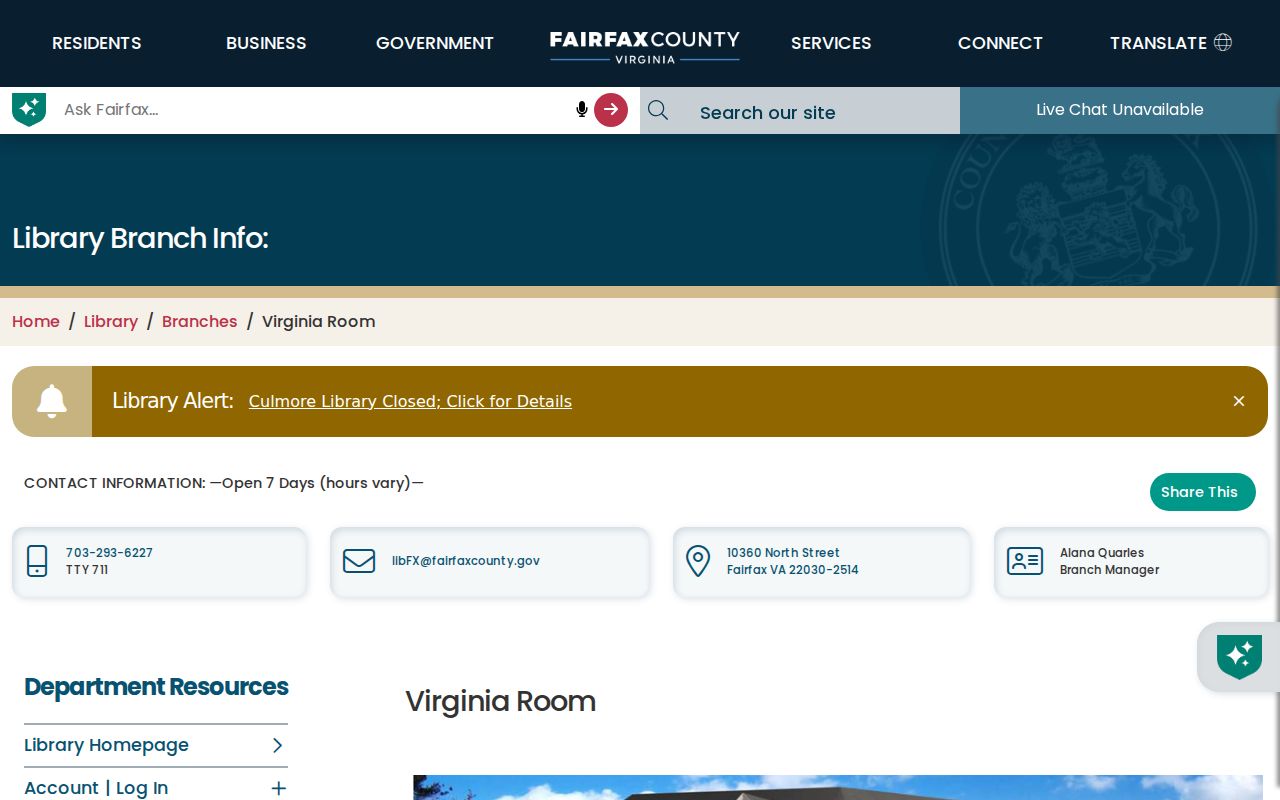
The library capture shows why a directory search can continue on site when an online catalog result lacks the needed shelf or microform detail.
Its on-site tools matter when an online hit stops short. The room has a microform reader-printer that can save to USB, a designated CPAN station for court records, eight internet stations, and library-access databases. That makes it possible to compare a directory address with a newspaper notice and then move to a land-record reference without treating any one source as the whole answer. Food and drinks are prohibited around fragile material, so plan note-taking accordingly.
The library-linked City Directories & Telephone Books guide is the source of this directory path, even though the research site returned an access limit during inspection.
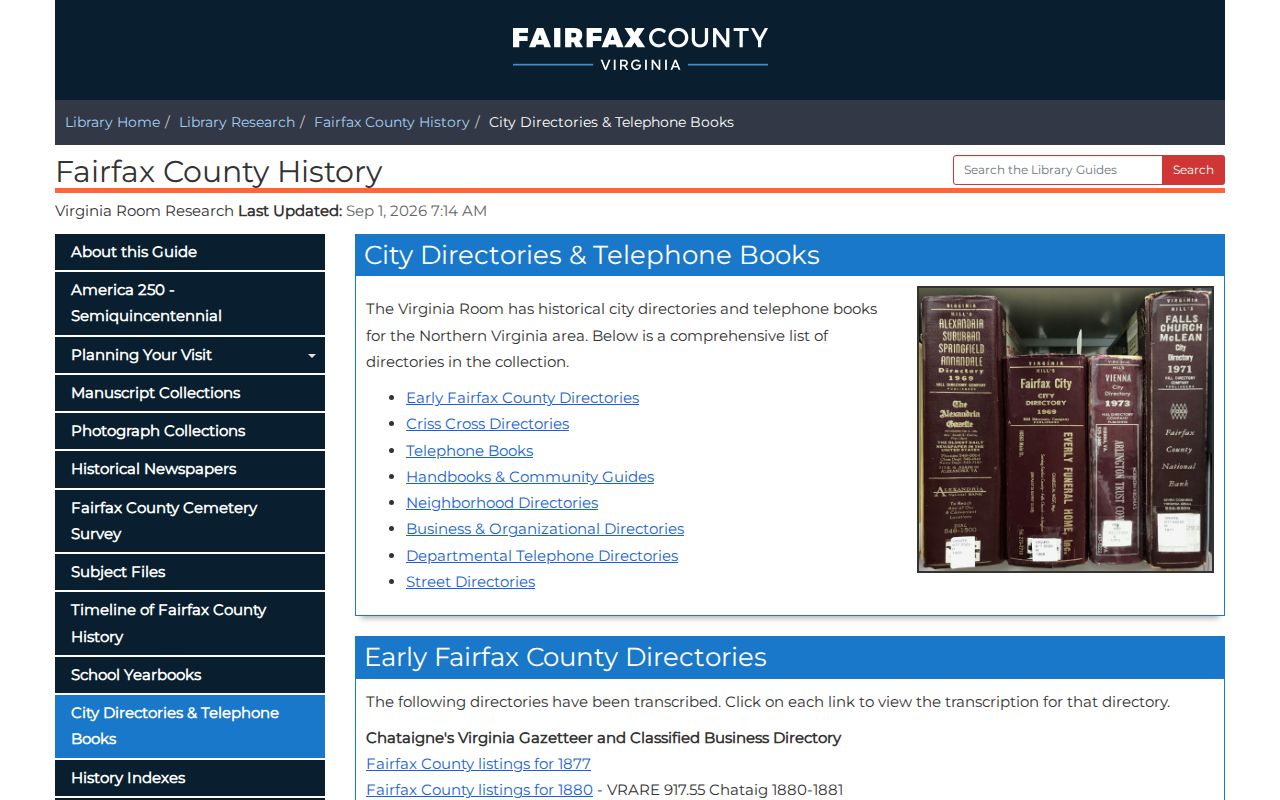
The captured guide points to the library layer where a title, date, and local call information can be checked before a household search begins.
Tysons Directory Postal-Label Quirk
A confirmed title is better than an invented run. The evidence supports Hill’s Fairfax City Directory in 1923 and 1963, Hill’s Alexandria Suburban Fairfax County Directory in 1966, and visible Virginia Room phonebook records for 1993, 1996, and 1997. The collection also points researchers to U.S. City Directories spanning 1822 through 1995 through Ancestry Library Edition. None of that proves that a particular Tysons house appears in every volume. Coverage must be tested volume by volume.
Use regional labels as search routes, not as competing jurisdictions. Fairfax County remains the local public-record custodian even when a directory uses McLean or Vienna. A postal city on a directory line may reflect delivery practice rather than the present CDP label. A name search should include accents, hyphens, alternate transliterations, initials, and spouse or parent names when known. Tysons has a diverse population and a single spelling can miss a household in an older index.
Directory evidence also needs a date. The street and person may be connected in that edition, but the line does not establish current residence. For a present address trail, use the current parcel and deed process on the Tysons streets page rather than projecting an old directory entry forward.
Note: Preserve the postal-place name exactly as printed, because an older McLean or Vienna label can still lead to a Fairfax County household.
Reading a Tysons Directory Line
No Tysons or Fairfax residential entry was available for direct inspection, so no publisher-specific abbreviation key should be assumed. Historical city directories generally arrange people or businesses alphabetically and may give a name, residence address, telephone, and family notation. A spouse may be in parentheses, and some books use short marks for residence, home, boarding, widowhood, or ownership. Read the key printed in the same volume before assigning a meaning to any mark.
The nearby 1890 Alexandria Gazette business directory, available as a regional comparison, visibly uses category headings, names, street addresses, descriptions, and advertisements. It does not show a Tysons household. Its value is limited to demonstrating why a date, publisher, and the page’s own key must stay attached to every transcription.
| Name form | Preserve initials, suffixes, spelling, and punctuation exactly as printed. |
|---|---|
| Address | Record the house number, street, apartment or building name, and postal place if shown. |
| Telephone | Note the exchange or number only as a dated directory detail. |
| Family notation | Keep a spouse, widow, boarding, or similar marker with the volume’s own key. |
| Supplementary notation | Preserve any publisher-supplied note with its volume and date, without assuming it confirms a current affiliation. |
- Criss-cross directory
- A street-order section that can list an address before the associated name. No Tysons-specific run was confirmed, so first check whether the chosen volume includes one.
- Householder index
- An index organized around the person or household named on the line, rather than every person who may have lived there.
- Abbreviation key
- The publisher’s explanation of shortened marks, usually found in the front matter. Photograph or transcribe it with the entry.
Tysons Directory Gaps in Print
When the right directory year is missing, the Virginia Room offers parallel material. Its Historical Newspaper Index, Washington Post Historical access, local newspapers, maps, photographs, manuscript collections, and subject files can add a dated address or family event. Regional papers sent for digitization include Annandale Recorder for 1955–1958, Fairfax County Independent for 1929–1933, Falls Church Echo for 1940–1955, and Falls Church Sun Echo for 1955–1967. They are regional titles, so a name or address result must be checked in context.
The Fairfax County Public Schools yearbook project offers more than 300 digitized scans from 36 schools, with nearly 500 physical yearbooks remaining in the Rare Book Room. These are useful companion sources for dated school and community context, not a substitute for a household roll. The FCPL yearbook collection information explains the digitized and physical split.
A Library of Congress 1861 Fairfax and Alexandria county map names landowners and depicts roads, houses, railroads, and landscape. It predates modern Tysons street addresses, but it can bridge an early landowner name to later deeds or tax books. Note: A title’s silence is a research limit, not a reason to fill the gap with a guess.
Tracing Tysons Directory Households
A family-history search works best as a dated sequence. Begin with the closest confirmed directory year and preserve the complete line. Then check the title before and after it, using the same name variants and address. A shift in street number, telephone exchange, spouse notation, or listing style may mark a move, a changed household, or a change in the publisher’s practice. Only compare facts that appear in the actual volume.
- Find the name or address in the best-matching regional directory and note the edition year.
- Copy the entire line, the page number, and the volume’s abbreviation key.
- Search neighboring years and nearby place titles for a move, alternate spelling, or changed postal label.
- Pair the directory date with the federal census available after the 72-year release rule. At the research date, 1950 is online and 1960 is not public under that schedule.
- Use newspapers, probate, cemetery material, or deeds to test whether a disappearance reflects a move, death, or simply an incomplete listing.
A census gives a household snapshot on its census date. A directory may fill years between those snapshots, but can omit children, renters, temporary residents, or adults who were not listed. The two sources complement each other; neither replaces the other.
Tysons Directory Backstops
Fairfax County’s older records extend well beyond the printed-directory shelf. The Fairfax Circuit Court Historic Records Center holds deeds, wills, tax books, chancery materials, marriage records, and other county records. Early deeds reach to 1742, and the center holds original wills from 1742 to 1935. Land-tax books cover 1851–1980, while Library of Virginia microfilm reaches historic land-tax lists from 1782 to 1927.
Those records have documented gaps. Some deed and order books are missing, term papers and judgments from the early county period are largely incomplete because of Civil War losses, and birth and death recording has a 1897–1911 gap. For African-American family research, the HRC’s 1822–1861 free-Black registration volumes can be important, although the volume around 1793–1821 is missing. A failed search may reflect a surviving-record gap rather than a missing person.
The Virginia Room joins the library shelf to these archival routes with its CPAN station, microform tools, and staff assistance. That is especially useful when a regional volume produces an address but not enough context to identify the correct household.
Note: Document the edition and page before moving to an archival source, because Fairfax’s surviving county records contain known gaps.
Tysons Directory Archives Beyond Books
The Virginia Room’s archive catalog, ARVAS, describes collections such as Election Files from 1950–2015, biography files, the Annandale collection, and a photographic archive dated broadly from about 1720 to 2007. Local photographs, oral histories, maps, and manuscripts can make a directory address more understandable without turning a printed line into proof of present residence. Collection descriptions and dates are useful when requesting archival material.
Tysons changed quickly through development, new streets, parcel phases, and overlapping postal labels. The county’s Master Address Repository keeps effective, change, and expiration dates that can help reconcile an older address with a current one. These printed volumes are strongest when used for the period they document, then paired with that address-continuity evidence and the Fairfax County land record.
Respect personal boundaries in historical research. A directory, photo, or notice may be public, yet it should be used for family history, estate research, or local history, never to pursue or harass a living person.